
The Western Weed Action Plan
In the western United States, several barriers cause invasive species management programs to become fragmented, inconsistent, and at times ineffective. The goal of the Western Weed Action Plan is to identify and implement consistent actions that overcome these obstacles to collaboratively and effectively address the impact and spread of invasive plants.
The Western Weed Action Plan and this webpage are divided into four sections:
The Western Weed Action Plan (WWAP) provides a strategic foundation for strengthening weed management capacity across the Western United States. It promotes effective, science-based policy and coordinated action to reduce the impact and spread of invasive and noxious plants throughout the region.
The plan’s pillars and supporting actions were shaped over years of dialogue, assessment, and collaboration among stakeholders directly affected by invasive weeds in the West, and were updated in 2025. It is designed as a living, adaptable framework capable of evolving as new challenges, insights, and innovations emerge. Individuals, landowners, government agencies, industry partners, and non-government organizations are encouraged to adopt and apply one or more of the pillars and actions to support their local and regional weed management efforts.
The WWAP framework is built around four core pillars, each representing a critical component of a successful invasive plant management program. Every pillar includes specific actions that guide planning, implementation, evaluation, and long-term success. Detailed descriptions of each pillar-and real-world examples and case studies from active western weed management projects-are provided below.
Weeds cross jurisdictional boundaries; therefore, land managers must collaborate to assess weed populations across jurisdictional boundaries and coordinate appropriate management responses.
Collaborative groups, like Cooperative Weed Management Areas (CWMAs), facilitate cross jurisdictional efforts by identifying shared weed management priorities and leveraging limited weed management resources.
An individual land manager or landowner on their own lacks the resources and authority necessary to address landscape weed problems in a timely manner or address the urgent need for early detection and rapid response to new invaders.
Individual partners may utilize different weed mapping, long-term monitoring, and management protocols that are incompatible, inhibit data sharing, and produce gaps in best information possible for management decisions or shared investment.
Weed species are having a financial, ecological, and community impact and increased awareness and buy-in is critical for long term weed management success.

The Weeds and Wildlife program at Hardware Ranch was started in 2017 and has several valuable aspects.
Regulatory [Federal, state, or local government] officials may designate any plant injurious to public health, agriculture, recreation, wildlife, or property a “noxious” weed. Once a weed is classified as noxious, authorities have justification to implement quarantines and take other actions to contain or destroy the weed and limit its spread. Weed Science Society of America WSSA-Weed-Science-Definitions.pdf Funding limited to noxious designation may create barriers for treatment of invasive weeds without a “noxious” designation and require alternative funding sources and leveraging among partners.
Federal, State, and local government entities regulate actions likely to promote the introduction or spread of invasive weeds and mandate measures be taken to minimize risk of harm. Executive Order 13112 – Invasive Species These regulations define the justification and tools needed to address weed impacts, but they also require significant time to complete compliance documents. After catastrophic disturbances, requirements are often relaxed, which reduces opportunities for timely prevention and response to both existing and new weed infestations, ultimately increasing ecological and financial consequences.
Local, state, and federal weed regulations can conflict and create regulatory hurdles to efficiently address weed infestations and are often forgotten in land management policy and regulation discussions.
Weed biology, ecology, and management is complex and varies across landscapes. Knowledge gaps exist and need to be filled to enable land managers to successfully address weed infestations and increase the return on investment for weed management efforts.
Research is necessary and must be designed to inform and create a solid science-based foundation for policy and management decisions. This helps ensure weed funding is obligated and well spent, management actions are successful in reducing weed impacts, and innovative weed management tools are identified and developed.
Successful weed management requires a long-term and consistent investment in staffing and funding.
Weed management prevents negative impacts from weeds across the west affecting communities, threatening livelihoods and the agricultural industry, natural areas, wildlife, and infrastructure, etc.
Many industries and groups are unaware that their activities introduce and promote the spread of weeds; nor do they recognize the benefit they receive from weed management.
Because resources are limited and weeds cross jurisdictional boundaries, successful weed management requires resource managers and other stakeholders to diversify resource investment and leverage co-investment to respond to shared high priority needs or impacts.
The Western Weed Coordinating Committee (WWCC) promotes healthy landscapes through land management projects to control invasive plants (weeds). The WWCC and partners developed the Western Weed Action Plan (WWAP) to guide conversations between partners and strategically approach weed management across the west.
WWCC received funding from the invasive species provision of the Bipartisan Infrastructure Law (BIL), H.R. 3684 (P.L. 117-58), to develop the Healthy Landscapes western weed project reporting HUB that allows partners to share information about noxious weed projects that included federal funding. The Healthy Landscape HUB feeds a dashboard Western Weed Dashboard (figure 1).
The Healthy Landscapes Dashboard enables partners to explore and display project information using a wide range of criteria, helping both collaborators and the public understand how weed management is being implemented across the region. Through flexible, on-demand filtering, users can sort and summarize projects within a single intuitive interface, including:
Custom project filters (Funding Source, State Partners, Funding Opportunity, Management Area)
Project contact information
Project view and engagement layers
Total project funding
Ecosystem categories
WWAP pillars and associated actions
Treatment activities (Herbicide, Biological Control, Revegetation)
Project descriptions and implementation details
Total acreage covered
Financial allocation and funding breakdowns

Ecosystem categories
Project descriptions and implementation details
WWAP pillars and actions
Custom project filters:
(Funding Source, State Partners, Funding Opportunity, Management Area)
See the projects that fit your filtered criteria
Financial allocation and funding breakdowns
Project view and engagement layers
Total project funding
Treatment activities (Herbicide, Biological Control, Revegetation)
Total project acreage
• Title
• Brief description
• List of links for more information
• Associated data (e.g., shapefile) required for identifying projects in the HUB that meet the new sort criteria.
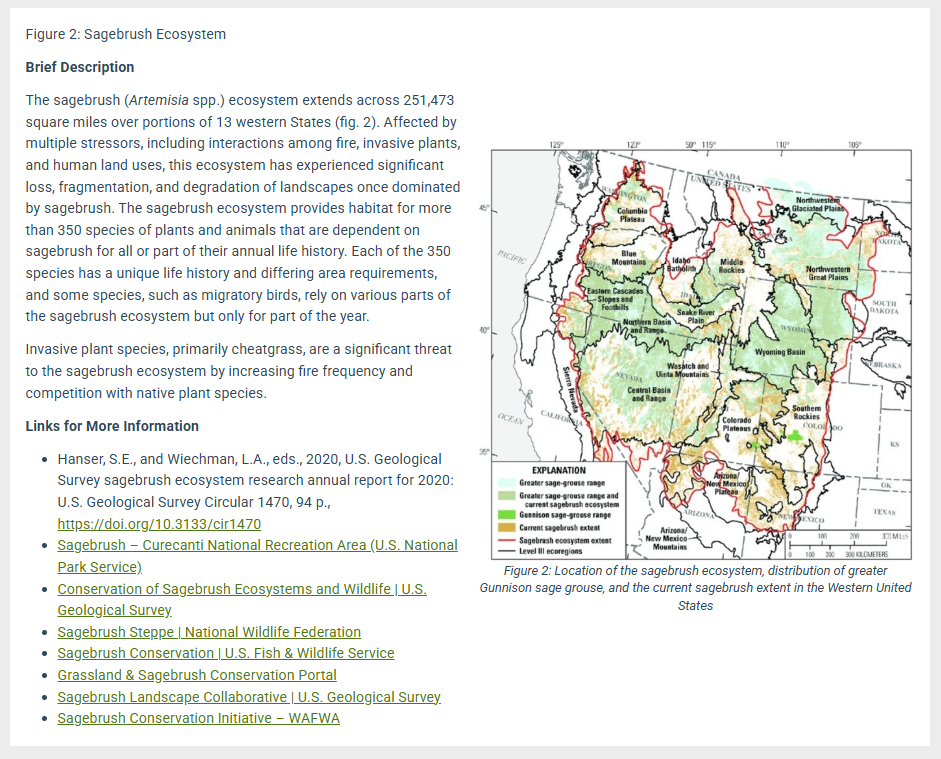 or
grassland
or
grassland
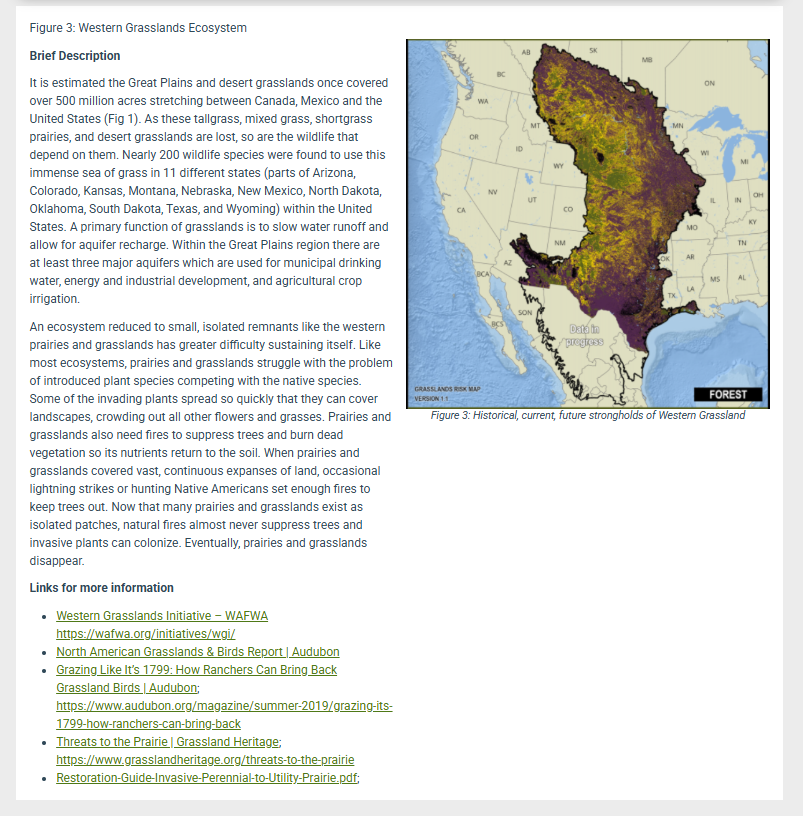 ecosystem boundary.
 The Healthy Landscapes western weed project reporting HUB
The 2019 WWAP attempted to track actions and sub-actions using a structured table format to support accomplishment reporting. However, this approach was not effective. The revision team concluded that there is no single universal method to evaluate progress toward WWAP Pillars and Actions because regional and state weed program managers prioritize different outcomes, and assessment tools must reflect the priorities of the evaluator.
The Healthy Landscapes Western Weed Project Reporting HUB offers a unified framework for tracking and evaluating weed management activities across the West. It supports assessment of projects that align with the updated WWAP, including Coordination and Collaboration (Pillar 1) and Funding and Capacity (Pillar 4), and will expand to encompass all WWAP pillars as additional evaluation tools are developed.
Initially designed to document projects with federal funding, the HUB is now part of a broader regional reporting effort. With support from the Bipartisan Infrastructure Law (BIL), H.R. 3684 (P.L. 117-58), western states are building their own state-level HUBs and dashboards to track state-funded projects alongside federally supported work. This model enables flexible reporting that reflects how projects are actually funded and managed on the ground.
The Healthy Landscapes HUB currently features 96 federally funded weed management projects across multiple western states. As states establish their own HUBs and dashboards, they are adopting shared data collection protocols-including those used by regional platforms such as EDDMapS-which strengthens interoperability and allows states to both draw from and contribute to the Healthy Landscapes dataset.
Growing participation increases the value of the reporting network. As more states add project data and launch their own dashboards, the collective record of weed management activity becomes richer and more actionable. This provides federal, state, and local partners with a clear picture of accomplishments, improves coordination, and supports reporting to funders and decision-makers. Public-facing dashboards also offer transparency and education by allowing communities to explore weed management projects in their area.
With continued expansion of the Healthy Landscapes HUB and state-specific reporting dashboards, WWCC will be able to more effectively champion regional weed management and measure progress toward meeting the goals of the WWAP.
Utah was the first western state to develop a public weed distribution and treatment HUB and dashboard. By collecting high-quality spatial data on weed occurrences and treatments, Utah built the foundation for a suite of additional dashboards that now display federally funded projects, state-funded projects, and weed biological control efforts.
Utah’s program represents a comprehensive and transparent model for weed management grounded in the Utah Noxious Weed Act (Pillar 2: Policy and Regulation). Success is driven by strong collaboration among the Utah Department of Agriculture and Food (UDAF), the Utah Weed Supervisors Association (UWSA), Cooperative Weed Management Areas (Pillar 1: Coordination and Collaboration), and Utah State University (Pillar 3: Science and Research). Through UDAF’s Invasive Species Mitigation (ISM) Grant Program (Pillar 4: Funding and Capacity), funds are allocated to projects with the highest likelihood of ecological success in Utah.To support strategic, data-driven investment, UDAF developed the Spatial Invasive Infestation and Priority Analysis (SIIPA 2.0) tool to help weed managers design high-quality projects and prioritize funding based on need, feasibility, and long-term ecological benefit. This workflow—from data collection, to prioritization, to funding, to implementation and public reporting—is illustrated in Utah’s Comprehensive Approach.
Using EDDMapS Pro, partners across Utah collect consistent weed distribution and treatment data that feed the Noxious Weed Dashboard. As projects are implemented, progress and outcomes are reported to the public through multiple dashboards, ensuring transparency and accountability. UDAF also conducts comprehensive project monitoring—capturing photos, control data, and reports—to evaluate success, refine best management practices, and communicate outcomes to legislators, stakeholders, and the public. Utah’s weed-free forage program adds another layer of prevention and monitoring to reduce weed spread across the state.

UDAF strengthens local Cooperative Weed Management Areas (CWMAs) by providing training and support in weed distribution and treatment mapping, SIIPA project development and ranking, and now in building CWMA websites. The CWMA Website Program is the newest component of UDAF’s comprehensive weed management strategy, enabling each Utah CWMA to create its own website with both technical and financial assistance from UDAF.
These locally managed websites automatically pull data from the Utah Noxious Weed Dashboard, as well as the federal, state, and biological control project dashboards. This allows CWMA members to focus on the weeds and projects within their boundaries without navigating state or regional platforms. Local websites foster collaboration by helping residents understand what is happening in their communities, highlight ongoing and completed projects, and elevate local needs—ultimately increasing visibility and encouraging grassroots participation in weed management efforts.
| CWMA Name | Website |
| Northern Utah | nucwma.org |
| Sanpitch | sanpitchcwma.org |
| Squarrose | squarrosecwma.com |
| Summit | summitcwma.org |
Utah’s weed management program continues to evolve as new challenges emerge. By prioritizing invasive species treatments through a data-driven approach, Utah is able to optimize resource allocation and focus efforts where they will have the greatest ecological impact. This strategy delivers lasting ecological and economic benefits for the state.
Show where weed projects are happening, how funds are used, and what’s been accomplished - statewide and by county
Give managers and legislators the data they need to prioritize funding, treatments, and follow-up work.
Help state agencies, counties, and CWMAs see each other’s projects and coordinate across boundaries.
Offer a clean public view of invasive species work, building support for long-term investments.

Visualizes weed management projects across Wyoming, highlighting treatment locations, funding sources, and partner activity in a single statewide view.
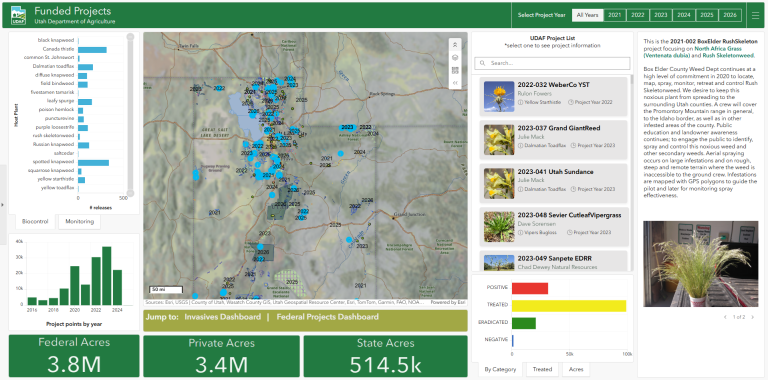
Tracks statewide noxious weed projects, treatments, and ISM grant investments, helping Utah communicate program outcomes to legislators and the public.
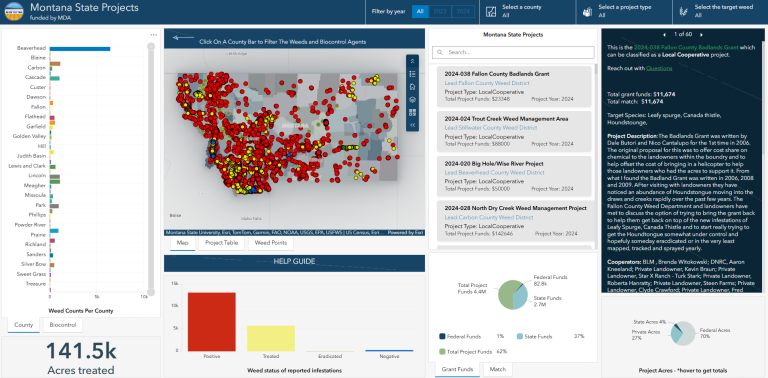
Provides a statewide picture of weed projects, treatment progress, and partner contributions, supporting program planning and funding justification.
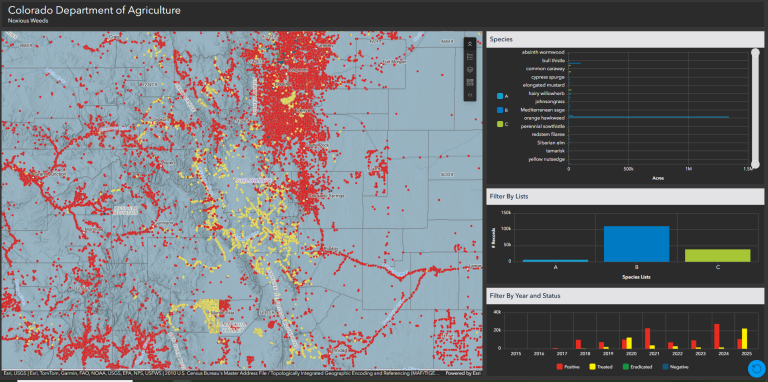
Interactive tool that maps weed management projects statewide and shows key details such as treatment locations, partners, funding, and outcomes.
We identify available data sources (treatments, distribution, grants, monitoring), field requirements, and reporting priorities for the state.
We connect EDDMapS, spreadsheets, and partner datasets so information flows automatically - with minimal manual uploads.
We build a clean public-facing interface that communicates results, tracks project performance, and supports real-world decision-making.
County weed supervisors, CWMAs, and state teams test and provide feedback to ensure the dashboard supports day-to-day needs.
We deliver training materials, walk-through sessions, and technical support so the dashboard continues to grow and improve over time.
The Western Weed Action Plan (WWAP) was initially established in 2019 as the “Western Invasive Plant Management: A Strategic Action Plan for the Sagebrush Biome.” This plan was the result of a four-year collaboration among state and federal agencies dedicated to investigating the threats posed by invasive plants to the sagebrush biome and setting goals for identifying and implementing actions to address infestations and weed spread.
Since its inception, the WWAP was intended to be a flexible document, subject to regular updates to meet the evolving needs of weed managing partners. The Western Weed Coordinating Committee (WWCC) assembled the Western Weed Action Plan Revision Team, hereafter revision team, to revise the WWAP to reflect current conditions.
The necessity for this plan stemmed from the widely recognized threat that harmful exotic plant species (weeds) pose to the important economic, environmental, and cultural values of western landscapes. Of particular concern are invasive annual grasses and other weeds that increase wildfire frequency and intensity. Weed invasions are directly linked to declining private property values, reduced land productivity and ecosystem health, and negative changes in local community lifestyles.
A persistent challenge identified throughout the development of both the original and revised WWAP was the lack of capacity to meaningfully address weeds across western landscapes. There is an ongoing need for persistent and consistent investments of resources—including time, tools (physical, cultural, biological, and chemical), personnel, and budgets—to manage weeds at all levels: local, State, and Federal.
In 2022, stakeholders at the WWCC annual meeting voted to update and expand the scope of the WWAP to represent the Western United States, rather than solely the sagebrush biome. The revision team, coordinated by the WWCC, used funding received through the invasive species provision in the Bipartisan Infrastructure Law (BIL) (H.R. 3684) to revise the plan and develop the Healthy Landscapes western weed project reporting HUB. This searchable HUB enables WWCC members to share information about federally funded noxious weed projects (Chapter 2). Furthermore, individual western states utilize WWAP-funded state dashboards to access information from both the Healthy Landscape HUB and state-funded project HUBs, using the project information to frame state noxious weed program evaluation and assessment (Chapter 3).
The resulting 2025 update, which expands the scope and updates the 2019 plan, is a call to action to address weeds across the Western United States. It provides a foundation to build justification for weed management capacity and develop stronger science-based policy. The four foundational pillars were retained but re-ordered and revised (Chapter 1), with new pillar descriptions reflecting the expanded scope. The 2019 actions were also revised to minimize duplication, additional actions were developed, and the 2019 sub-actions were removed.
| 2019 Pillars | 2025 Pillars |
| 1) Funding | 1) Coordination and Collaboration |
| 2) Policy and Regulation | 2) Policy and Regulation |
| 3) Coordination, Collaboration, and Data Sharing | 3) Science and Research |
| 4) Research and Reporting | 4) Funding and Capacity |
The revised WWAP reflects a collaborative effort across diverse agencies and is unified by the common concern that weed expansion negatively affects the Western way of life, economy, landscapes, and wildlife. The WWCC is dedicated to making the WWAP a “living document” by tracking its implementation and accomplishments manifested through weed management projects.
Troy Abercrombie- Oregon Department of Agriculture
Jasmine Chaffee- Montana Department of Agriculture
Michelle Cox- USDA Forest Service
Seth Flanigan- Bureau of Land Management
Lindy Garner – U.S. Fish and Wildlife Service
Ken Mayer – Western Association of Fish and Wildlife Agencies
Joseph Milan – Bureau of Land Management
Carol Randall- USDA Forest Service
Daniel Tekiela- USDA Forest Service
Lindsey Woodward- Wyoming Department of Agriculture
Western Weed Coordinating Committee (WWCC). 2025. Western Weed Action Plan: A Call to Action for the Western United States 2025-2035 Update. Western Weed Action Plan Revision Team, Western Weed Coordinating Committee.
ArcGIS Online dashboards are tailored to state weed programs: connecting project data, funding, and partners into a single, public-facing view.
Downey, P. O., Paterson, I. D., Canavan, K., Hill, M. P. (2021) Prioritisation of targets for weed biological control I: a review of existing prioritisation schemes and development of a system for South Africa, Biocontrol Science and Technology, 31:6, 546-565, DOI: 10.1080/09583157.2021.1918636 To link to this article: https://doi.org/10.1080/09583157.2021.1918636
Faccenda, K. and Daehler, C.C. (2022) A screening system to predict wildfire risk of invasive plants. Biological Invasions 24: 575-589. https://doi.org/10.1007/s10530-021-02661-x
FIPMCC. 2018. National Roadmap for Integrated Pest Management. https://www.usda.gov/sites/default/files/documents/IPM-Road-Map-FINAL.pdf
Gerwing, T. G., Hawkes, V. C., Gann, G. D., and Murphy, S. D. (2022). Restoration, reclamation, and rehabilitation: on the need for, and positing a definition of, ecological reclamation. Restoration Ecology 30(7) 1-4.
Hawaii’s Coordinating Group on Alien Pest Species (cgaps.org)
Institute for Managing Annual Grasses Invading Natural Ecosystems (IMAGINE)
NAISMA. (2018). Mapping Standards for Program Managers. 34 pages.
NISC. (2018). Enabling Decisions that Make a Difference: Guidance for Improving Access to and Analysis of Invasive Species Information. [Advances MP16–18 2.4]
NISC. (2022). NISC White Paper, Federal Invasive Species Rapid Response Fund: Criteria and Considerations for Establishment (May 2022)
NISC. (2022). NISC White Paper, Rapid Response to Invasive Species: Federal Agency Roles (October 2022)
Parsons, E. (2024). Post disturbance rapid response. Pacific Islands Regional Invasive Species Climate Change (PI-RISSC). Concept introduced during the 2024 International Invasive Species and Climate Change Conference https://www.youtube.com/watch?v=R-c5yAKOUFk&t=8455s at timestamp 2:19:12.
The U.S. Department of Agriculture Animal and Plant Health Inspection Service. (2024). Noxious Weeds Program Risk Assessments. https://www.aphis.usda.gov/plant-pests-diseases/noxious-weeds/noxious-weeds-program-risk-assessments#:~:text=PPQ%20conducts%20weed%20risk%20assessments,harm%20in%20the%20United%20States.
The U.S. Department of the Interior. 2016. Safeguarding America’s lands and waters from invasive species: A national framework for early detection and rapid response, Washington D.C., 55p
The U.S. Department of the Interior Early Detection and Rapid Response | U.S. Department of the Interior (doi.gov); https://www.doi.gov/invasivespecies/early-detection-and-rapid-response
Wallace, R. D., Bargeron, C. T., Reasor, J. K. (2020). Enabling decisions that make a difference: guidance for improving access to analysis of invasive species information. Biological Invasions 22:37-45.
Western Governors Association. (2022). Biosecurity and Invasive Species Management Policy Resolution 2022-11. https://westgov.org/images/editor/WGA-PR-2022-11-Biosecurity-and-Invasive-Species97.pdf
Winston, B. (2022). Spatial Invasive Infestation and Priority Analysis (SIIPA) modeling tool: Online map guide- Invasive Species Management Training Guide. Utah Department of Agriculture and Food. 36 pages. https://ag.utah.gov/wp-content/uploads/2019/12/Utah_SIIPA_Guide.pdf
Acronyms/ Initialism and Links
ANSTF Aquatic Nuisance Species Task Force
CWMA Cooperative Weed Management Area
EDRR Early Detection Rapid Response
FICMNEW Federal Interagency Committee for the Management of Noxious and Exotic Weeds
FIPMCC Federal Integrated Pest Management Coordinating Committee
IPM Integrated Pest Management
NAISMA North American Invasive Species Management Association
NISC National Invasive Species Council
PDRR Post Disturbance Rapid Restoration
SIIPA Spatial Invasive Infestation Project Analysis
TES Threatened and Endangered Species
To enter in your federal project information please visit our reporting form page.
Members of the Western Weed Action Plan Revision Team:
Troy Abercrombie- Oregon Department of Agriculture
Jasmine Chaffee- Montana Department of Agriculture
Michelle Cox- USDA Forest Service
Seth Flanigan- Bureau of Land Management
Lindy Garner – U.S. Fish and Wildlife Service
Ken Mayer – Western Association of Fish and Wildlife Agencies
Joseph Milan – Bureau of Land Management
Carol Randall- USDA Forest Service
Daniel Tekiela- USDA Forest Service
Lindsey Woodward- Wyoming Department of Agriculture
Suggested Citation
Western Weed Coordinating Committee (WWCC). 2025. Western Weed Action Plan: A Call to Action for the Western United States 2025-2035 Update. Western Weed Action Plan Revision Team, Western Weed Coordinating Committee.